

Last activity on February 7, 2026
Toward the bottom of this section, I will discuss some epiphanies that I’ve had about being a nondrinker in a society awash in booze.
After reflecting on this subject for a very long time, there’s one epiphany that really stands out…
I’ve realized that there is only one thing that you need to successfully navigate your social life without drinking.
Once you attain it, you will never desire to “just have a drink” because everyone else is doing it.
You will have something that is infinitely more important than any social situation you find yourself in.
What you need is a sacred sense of purpose in your life. When your life revolves around this sacred sense of purpose instead of alcohol or even abstinence, you will have experienced an identity shift.
What’s more, this sacred sense of purpose will enable you to place a low value on the irrational herd mentality that surrounds alcohol consumption.
It will ultimately allow you to enjoy yourself in the company of people who are drinking, without thinking for a second that drinking is the best course of action for you.
Many people who manage to detox and stay “sober” for awhile return to drinking because they can’t resist the desire to be like everyone else.
They can’t resist this desire because, on some level, it is natural.
You will have to confront and reject this desire from time to time, until doing so feels more natural than the desire itself.
People who relapse back into alcohol addiction also tend to suffer from the following fatal flaws:
All of the above are destructive neural patterns that result from the failure to self-examine and achieve a meaningful shift in identity.
If you walk around calling yourself an alcoholic, your behavior will conform to your limited view of yourself. Even if you define yourself as a “recovering alcoholic,” your identity will revolve around alcohol.
What if you were to forge a new identity as a fitness enthusiast? Or a world traveler? Or a book worm, or even an accountant with a passion for cooking? Your identity would then transcend alcohol, and you would discover very quickly (as I did) that other people find you much more interesting than typical bores who stand around and drink.
By doing some self-examination now, you have the power to determine exactly who you will become in the future.
Write down some thoughts by hand and keep them in a place where you will see them daily…
When I quit drinking, I wanted to develop and project my own Integrity, Compassion, and Intellect. The values that I wanted to enjoy more of were Fitness, Freedom, and Adventure.
(Family and Friendships were my highest values, but I was lucky not to have burned any bridges before I quit drinking. These were therefore not values that I needed to actively pursue on a daily basis.)
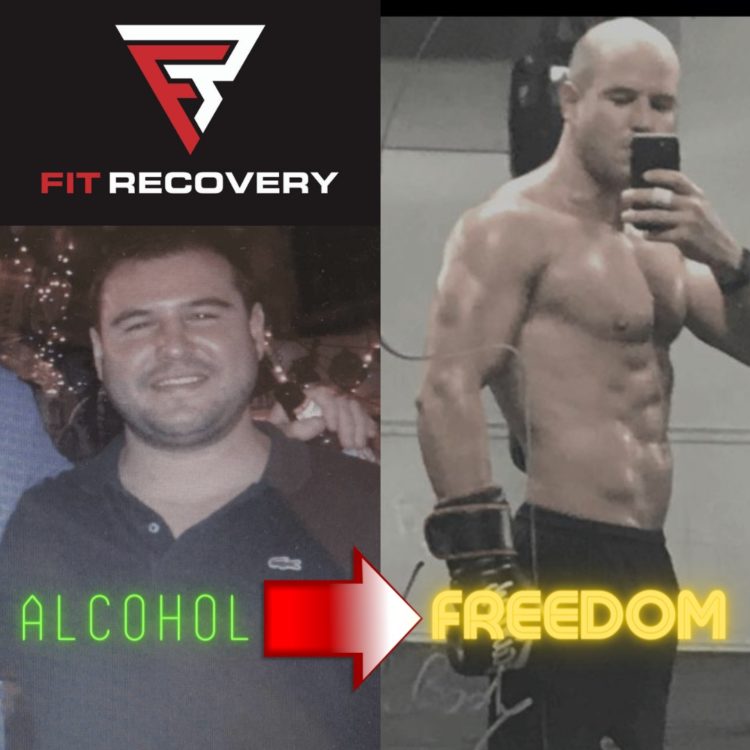
My goals included getting as fit and as healthy as I could possibly be, and fusing my traits and values into a new career path. I became a personal trainer and started Fit Recovery, without knowing whether either of these decisions would pay off.
My primary goal – for a long time, you could say this was my Life’s Purpose – was simply to figure out what on earth my Life’s Purpose might be.
Your notes do not need to look anything like mine. But feel free to use my experience as a blueprint.
Watching my private coaching clients make progress in their personal lives, and strengthen their newly clarified convictions, has been an extremely rewarding process for me.
I often recommend Awaken The Giant Within to them as an in-depth guide for this kind of self-discovery.
Become addicted to your own self-improvement – physically, mentally, and spiritually – and I guarantee that your social life will improve automatically.
By becoming the best version of yourself, you are not only maximizing your potential in myriad ways, but assuring that other people will detect your level of self-respect, and treat you accordingly.
1) Few people notice, much less care, if you’re not drinking. I tend to order club soda with lime at events. Most people probably assume that it’s a vodka and tonic. I’m so focused on the people that I’m with, that my non-alcoholic libation rarely comes up as a topic of conversation. When I’m out late with friends, such as for a New Years Eve celebration, I order coffee at bars – and have never gotten any pushback from the bartender.
2) Nothing magical ever happens after midnight at parties, weddings, dinners, or events. People begin to talk in very serious, hushed tones about subjects that don’t matter at all. Most of them can’t remember what anyone said a minute ago. Yet millions of people claim that they live for these “times they’ll never remember” with people who, in many cases, they’ve already forgotten.
3) After the age of 25, drinking culture subsides drastically – except for alcoholics and “borderline” alcoholics. I went to a heavy-drinking college. My friends and I went out almost every night. I was the only one who was predisposed to alcohol addiction (as far as I know), and I continued to drink heavily after college while my friends effortlessly cut down to negligible alcohol intake. Life is MUCH MORE than a series of drinks, despite our booze-obsessed youth culture. Rise above it!
4) If I’d been smart enough to quit drinking in high school or college, I would have dramatically improved the course of my life. And I would have had a role model – a friend who had never drank because his parents were severe alcoholics. The mental frames through which he allowed himself to perceive his life were VERY strong. He did not isolate himself socially, and he never felt unfairly deprived.
5) “I can’t drink anymore because I’m an alcoholic” makes you sound like a deprived loser. “I used to drink too much, so I quit” makes you sound like a winner with strong character. It’s best not to care too much about what other people think. But no one wants to be looked at like they have an extra arm or leg. Cultivate your internal strength, control the frames through which you view your life, and people will not be able to help but follow your lead.
6) People who give you a hard time for not drinking are either addicted to alcohol, extremely insecure, or both. These people are not worth your time. If they’re strangers, you don’t have to associate with them anyway. If they are family, give them an ultimatum: Cut it out, or we’re not associating anymore. No one’s opinion should be allowed to get in the way of your goals.

7) Keep the messy details of your struggle limited to your close circle of friends and/or family. I’ve met a lot of people who have somehow found out about my battle with alcohol addiction, and then secretly told me, “I wish I could do that.” If I had gone around preaching about my view of alcohol or my life story, these people would think that I’m just a self-righteous prick.
8) For several months after I quit drinking, I had to suppress a bit of envy for friends who went out and partied on the weekends. My brain chemicals were not yet balanced, and my system craved the artificial release of endorphins, dopamine, serotonin, and GABA that I knew my friends were getting. Once I realized that alcohol only monopolizes brain chemicals that we can produce ourselves through a range of activities – and once I restored them through supplementation and lifestyle changes – I no longer felt deprived.
9) Once your brain heals, you won’t even notice that other people are drinking. When I see people drinking, I think to myself, “Been there, done that. What’s new?” There’s nothing new or exciting about alcohol. There’s no point in obsessing over something you’ve done a thousand times with bad results. I went to a wedding recently, had a great time, and it occurred to me on my flight home that a lot of people had gotten drunk and several mid-30s adults had vomited.
10) Long-lost genuine friends will probably surprise you by being VERY supportive of your decision to quit drinking. I used to be nervous about telling a few friends from my college days that I would not be drinking with them anymore. I really admired these guys, but we used to drink frequently and heavily. When we finally caught up after several years of work-related distance, I was pleasantly shocked to find that we had been genuine friends all along, and that our friendships had not revolved around alcohol.
11) Most people (women in my experience) are receptive to coffee dates. “I used to drink too much, so I quit” is now my universal line for questions about why I don’t drink. 95% of the time, the response is “Wow, good for you” – and when the woman perceives that I have a purpose in life, my disinterest in alcohol becomes a non-issue. It’s also amazing how many people have their own tragic stories about alcohol addiction and ex-boyfriends, family members, or best friends. Don’t assume that you’re out of the dating game because you no longer drink…You can have a fantastic time drinking coffee and eventually, having club soda while your date has a glass of wine. As for heavy drinkers…Who wants to date one of those?

12) If you ever want to experience a manageable buzz without disorientation, hangovers, or withdrawals, there are herbs, nootropics, and natural highs that you can use for that purpose. Mind-alteration is not inherently evil. We are evolutionarily wired to pursue mild-alteration, in one form or another. Alcohol is a sub-optimal way to achieve this because it is toxic, and because many of us are predisposed to alcohol addiction. I would take phenibut, kratom, or kava over alcohol any day.
13) I feel AWESOME now that I’m totally clear-minded. On some days I live like a complete monk. I cut out caffeine, carbohydrates, and even exercise. These days make my next big meal and next big workout feel absolutely amazing. When I say that there are alternatives to alcohol, I’m not arguing that we need to spend our lives chasing highs. The best euphoria can be achieved without anything at all.
14) If you can’t imagine never drinking again with your friends, commit to an indefinite break to let your brain heal, repair, and rewire. There are many people who have great social lives and never drink because they don’t like the way it tastes. These people aren’t missing out on anything. You’re not missing out on anything either. Remember that cravings are deceptive impulses that evaporate once your brain heals.
15) THERE ARE SO MANY SECRET ALCOHOLICS! I can walk into a restaurant bar and immediately identify who has a problem with alcohol. Alcohol addiction is so common that it’s illogical to feel alone. Feel gratitude for escaping from this biochemical trap. I believe that alcohol addiction is underreported; the 13% of self-reported alcoholic Americans is probably closer to 20%. That’s 1 in 5 people! There are many other people who will wish, on their deathbeds, that they had achieved the kind of transformation that you have already begun.
Epiphanies tend to take time, but they can hit you like a ton of bricks and alter your perception of reality.