2 // Understanding Alcohol Addiction » Set Your Intentions
Last activity on February 7, 2026
Moderation: The Elephant In The Room
The Taboo Question
“Is it possible to beat alcohol addiction – and then to drink moderately?”
At some point or another, this question torments everyone who becomes addicted to alcohol.
It is a taboo question in the addiction treatment industry. This is precisely why I want to address it.
Looking back, I see that if I had known some basic facts about this issue sooner, I would have avoided a lot of pain in my life.
This section is dedicated to helping you approach this issue rationally, rather than dogmatically, so that you can come to an informed conclusion for yourself.
Studies On Alcohol Moderation
When I finally got help for my alcohol addiction, I was never presented with scientific research about my odds of successfully reprogramming myself into a moderate “social drinker.”
I was simply told that it was impossible, and provided with no explanation beyond “because addiction is a disease with no cure.” It sounded to me like my counselors didn’t want to ever see a cure.
Moderation is the dream of anyone who is still physically addicted to alcohol. This makes sense, because we are always trying to rationalize behaviors that we cannot seem to change.
Here are a few more things I have learned about moderation, all of which I wish I’d known YEARS ago:
In 1973, a study claimed to reform 20 alcoholics into social drinkers using therapy with an 85% success rate after two years. Ten years later, a review of the evidence found that seven had resumed heavy drinking, four had died from alcohol-related causes, one was missing, six had been hospitalized and become abstinent, and one of them – who had never experienced withdrawal symptoms, and was misclassified from the start – had remained a social drinker. (source)
In 1985, a New England Journal of Medicine study followed 1,239 alcoholics for seven years. It found that about 20 of these people (under 2%) were drinking socially by the end of the period. 79% were drinking heavily, 14% were dead, and 7% had quit drinking entirely. (source)
Moderation Management, which uses teaches drinkers to cut back, has been found to work almost exclusively for people who are psychologically but notphysically dependent on alcohol. (source)
Long periods of abstinence don’t seem to do much for even the most successful alcohol-addicted people. Just take a look at tabloid articles about mega-rich stars like Ben Affleck or Shia Labeouf.
Now here’s the caveat to the above statistics and anecdotes: As far as I know, none of these people ever embarked on a program of biochemical repair or Bio-Pyscho-Social-Spiritual optimization. We will see in the below sections why this may be relevant.
So Is Moderation An Impossible Outcome?
I’d be lying if I said that I don’t know any people who have struggled with alcohol in the past, spent a considerable amount of time rewiring their brains and rebalancing their bodies, and gone on to drink alcohol sporadically without becoming “re-addicted.”
Therefore, rather than take the easy route and tell you what 99% of “recovery experts” will tell you, which is…
“No one who has ever been addicted to alcohol will ever be able to drink moderately.”
…I’ll present you with an honest, rational and science-based perspective, even if it’s a bit more confusing at first. If you’ve gotten this far, you’re smart enough to handle the nuances!
After years of scouring everything I can find on the subject and learning from the experiences of my clients, here is what I have discovered:
There are alcohol-dependent people who drink slightly more than moderately, yet who do not fall into the trap of withdrawal and kindling. I have had clients like this, and I have reached three conclusions about them: 1) There may be complex biochemical reasons that could explain why these people manage to drink too much and yet never descend into severe addiction, 2) These people are almost always made miserable and unhealthy by their drinking habits anyway, 3) There is no guarantee that these people will not eventually descend into severe addiction – i.e., their descent may simply be much slower.
Alcohol-dependent people who take naltrexone are often able to drink moderately, although the most addicted of these people typically need to detox off of alcohol first. This is called The Sinclair Method, and it will be discussed in this course. The caveat is that naltrexone blocks pleasure from drinking. Many people who use this method ultimately choose abstinence voluntarily.
Some people have used hallucinogenics such as ibogaine or psilocybin to alter their neural pathways in ways we cannot yet explain. Some of them have recovered from alcohol addiction in very short periods of time, and a minority of them even begin to drink socially. These substances are illegal in the U.S., but some treatment centers utilize them in Europe, Africa, and Mexico.
Some people who have been addicted to alcohol (and even experienced severe withdrawal) have been able to resume drinking moderately many years later, perhaps because they have physically rewired their brains and fixed all of their preexisting imbalances. If this is the case, then the apparent “inability” for “alcoholics” to drink “moderately” may be explained by the fact that the vast majority of alcohol-dependent people never succeed in a) taking a long enough time off of alcohol, b) doing everything necessary to physically rewire and rebalance their brains, and c) honestly reassessing their belief systems and forging a new identity beyond BOTH alcohol and the rehab-created construct of the “perpetually powerless addict.”
I harbor no desire to drink moderately. For me, alcohol is a moot substance, and moderation is a moot question.
Here is a brief rundown of the reasons behind my own apathy toward the idea of moderation:
I feel GREAT 90% of the time. Alcohol has nothing to offer me in terms of lifestyle improvement.
I suspect that I have long struggled with a mild underlying deficiency in GABA and/or endorphins, which I’ve fixed through supplementation, diet, exercise, and meditation.
Once I grasped the underlying causes of my own addiction (including my prenatal alcohol exposure), quitting drinking and helping others felt like aligning with my destiny. I now have a purpose in life that gives me vastly more pleasure on a daily basis than toxic alcohol ever did.
There is no problem that an artificial buzz solves for me, because I no longer need or want to disconnect from reality or other people. I want to deepen my sense of connection!
It’s possible that I instead of becoming a drinker, I could have instead formed a special bond (and series of neural pathways) with pain pills, cocaine, benzodiazepines, or some other drug like meth. Alcohol is more socially acceptable than these drugs, but it’s not less dangerous or addictive. If I lived in a society where “occasional” use of hard drugs was socially expected at dinner – or if we had bars where everyone just took Xanax and meth – would I fall into line like a sheep and try to “moderate” them? Hell no, I value my life too much!
I don’t need any extra calories, and everything we consume while drinking gets turned into fat because the liver is preoccupied for hours with breaking down toxic alcohol.
Alcohol numbs the taste buds. Food tastes so much better now that I don’t drink! The idea that alcohol ever tasted great was an illusion.
When I drank, I really hated the sensation of alcohol wearing off. If I were to drink again, I’m not sure if I could avoid the inevitable “bummer” feeling of the drink wearing off. This sensation might outweigh any benefit I would receive from the 15 minute per drink buzz.
Even moderate drinking has been shown to contribute to seven types of cancer. (source)
My good friend and co-host on The Elevation Recovery Podcast, Matt Finch, drank not just “moderately” but also “minimally” and “socially” – many years after he beat both alcohol and opiate addiction. He appears to have been in the small category of people who successfully rewired their brains, rebalanced their biochemistries, and forged a new identity and belief system that were incompatible with the heavy-drinking / addicted lifestyle. He did not “turn back” to alcohol to cope with negative emotions, he merely allowed himself to have 1 or 2 drinks sporadically and with certain company. Interestingly, he says that alcohol soon bored him after he chose to allow himself to drink it again, and that increasing dosage to 3 or 4 drinks just made him feel uncomfortable and “toxified.” Now he can’t recall the last time he had a drink (probably sometime in 2019).
Last but not least, what does “moderation” even mean? Depending on which country you live, it’s defined as having a set number of drinks per day and/or per week. “Moderate” in this context is a vague term that seems to mean something like “average” or “safe” – but I’m not sure why we’d value the averages in populations that drink a lot (and whose averages are tilted vastly upwards by alcohol-dependent people), and studies have now established that no level of alcohol is safe from a health perspective. Regardless of which definition we choose, it seems like a stretch to refer to daily drinking at any level as “moderate.” Even if you decide there’s a net benefit to “toxifying” your body with alcohol in some context or another, there’s little sense in incorporating a poison into your daily routine.
I love life beyond alcohol, and I promise that you can feel the same way! Once you learn to love your life each day, and to live fully in each moment, then alcohol will become an exhausted resource for you.
Instead Of Vague Terms Like “Moderation,” Focus On Taking A Break To Dominate Addiction
I used to be VERY upset that I “had” to quit drinking. (I didn’t have to, but I did anyway – because deep down, I wanted to.)
I don’t like having to do anything. Coercion isn’t my cup of tea.
No amount of grim statistics, catchy rehab industry sayings, or external force could have given me the motivation I got from rationally reassessing the role of alcohol in my life and vowing to do everything in my power to build my life back up from scratch.
Today, not only do I have no desire to drink, but the very idea of it disgusts me – in a visceral way; in the same way that I have no desire to eat a hairball off the floor of a public restroom.
Like alcohol, that hairball has nothing to offer me except for risks that I most certainly don’t want. At least the hairball won’t turn me into a passionate hairball-eater after I digest it. And it probably won’t give me a higher risk of seven types of cancers or liver disease, or make my IQ drop by 20 points.
(An IQ test administered two weeks after I’d quit drinking found that my intelligence had dropped by 20 points since my last test in elementary school. Alcohol slowly turns you into a dumbass!)
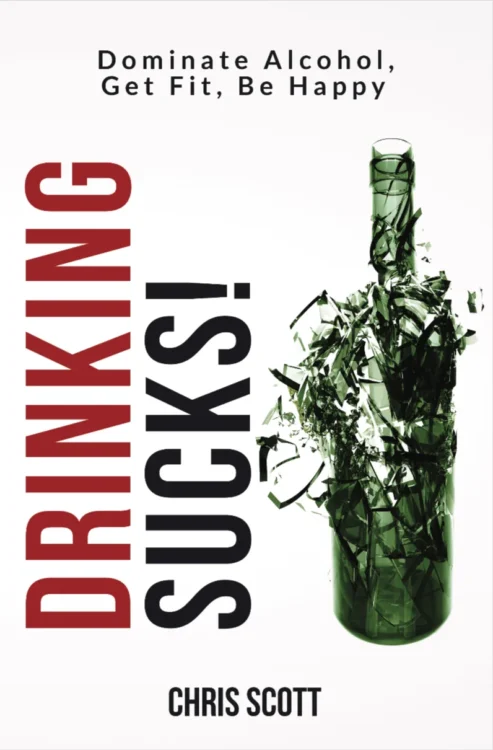
I can’t put my general sentiment into words any better than I already did in my short book, Drinking Sucks:
“It would be a tall order for scientists to invent a pill that preserves alcohol’s temporary, object-less euphoria while eliminating disorientation, dehydration, increased fat storage, cell mutations, headaches, hangovers, and withdrawals. Ethanol is a hell of a toxin.“
“While I sit here writing this, I feel more alive and more euphoric than I ever did during my drinking years. Of course it’s possible to feel good without booze – don’t you remember running around for no reason when you were a kid? Alcohol simply monopolizes positive emotions that you used to take for granted as natural daily occurrences.“
I’m not asking you to commit to taking the rest of your life off of drinking alcohol. I can’t force that conclusion upon you. I earnestly hope that after you finish this course, you see how much life beyond alcohol has to offer – and reach the best possible conclusion for yourself.
Instead of focusing on the rest of your life, commit to taking a break to dominate alcohol addiction using any of the methods, or any combination of methods, that you’ll learn in this course.
If you are severely addicted to alcohol, you will almost certainly find it necessary to take an indefinite period of time away from alcohol so that you can regain control over your body, mind, and spirit.
Pro Tip: Biochemical rebalancing with supplements and lifestyle changes can make you feel better quickly, but it can take longer for psychological/neural rewiring to occur. This is because we have to accumulate new experiences with a new physiology along with a new mindset to really enjoy life without alcohol. This means that you can start feeling good without alcohol very soon…But you won’t reap the full change in perspective until you’ve worked your way up the Hierarchy of Recovery. Trust me, it’s worth it!
Enter your email and receive the PDF Version of Chris Scott’s bestselling book, Drinking Sucks!
We do not sell or share your information with anyone.
“This book has been very helpful and inspiring to me in an attempt to quit drinking. Even after reading the whole thing, I pick it up for inspiration. I have chosen to go into outpatient therapy, but the book has helped me stay on track.” – Satisfied Customer